Showing posts with label Stereotypes. Show all posts

Monday, August 15, 2016

Equality, Eggs, and Nest Eggs

You never thought this would happen. As a teenager it was drilled into your head that having sex without using birth control would surely result in a pregnancy. Now you are an adult, you want to have a baby, and it is not happening.

So what do you do? You probably talk with a doctor and maybe she suggests some infertility treatments. One of the cheaper interventions is Artificial Insemination: injecting sperm into the uterus during ovulation. This costs on average $865, although the price can vary considerably. Other interventions like In Vitro Fertilization (embryos are created from sperm and egg and then inserted into the uterus) cost an average of $8,158, with additional expenses up to $5,000 for the medication used to increase egg production prior to each treatment. Because there is no guarantee of pregnancy, these procedures may need to be repeated many times before it occurs, if it occurs at all. With yearly college tuition costing $9,000 - $30,000 it is possible to spend more trying to create your child than to educate your child.


Insurance lightens this burden for some but not everyone has health insurance or insurance policies that cover infertility treatments. As of 2016 only 15 states in the U.S. require that infertility treatments are covered by private insurance; and even in those states there are exceptions based on a woman's place of employment and the specific insurance plans offered through that workplace. In some states insurance companies' definitions of infertility (failure to conceive after a year of unprotected heterosexual sexual intercourse) also unfairly deny lesbian women coverage.

Blanchfield and Patterson (2015) raised further concerns about access to infertility help and insurance coverage. They evaluated data from thousands of women who participated in the 2002, then in the 2006-2013 waves of the National Survey of Family Growth (NSFG) to determine if racial minority women (non-White) and sexual minority women (lesbian women and women who report sexual attractions that are not exclusively heterosexual) have the same access to "fertility assistance" and insurance coverage as women in related majority groups.

From 2002 to the most recent wave in 2013, about twice as many White women compared to racial minority women reported getting medical assistance for pregnancy. Heterosexual women were also more likely to receive this help compared to sexual minority women. However, regardless of race or sexual orientation, women who received help reported getting the same forms of assistance, including advice, testing, fertility drugs, and Artificial Insemination.

Private health insurance coverage varied by race and sexual orientation with White heterosexual women being most likely to have this financial help. In 2002, this comparative lack of insurance and related lower income failed to explain racial and sexual minority women's lower rate of medical assistance for pregnancy: even when these women could pay for these services they were less likely to receive them. However, from 2006-2013, lack of insurance coverage was enough to completely explain the persistent lower level of medical assistance for sexual minority women's infertility. In other words, if sexual minority women can pay for the treatments they are now just as likely to receive them as heterosexual women. On the other hand, even from 2006-2013 lower income and lack of insurance could only account for part of the persistent lower level of medical assistance for racial minority women's infertility. This means that even when non-White women have the means to pay they do not always get these interventions.

This is particularly disturbing as White, Black, and Hispanic women have approximately the same rate of infertility (11%) and these groups represented more than 90% of the women surveyed in the NSFG. Thus with equal means to pay, these groups should have reported equal experience with medical assistance. Blanchfield and Patterson (2015) offer three possible explanations for this racial discrepancy. First, racial minority women may not have the "social support" that White women have when they are faced with infertility: if your friends and family don't suggest talking to a doctor then you are less likely to do so. Second, for Black women in particular, our nation's history of abusing Black citizens for medical testing (see for example: U.S. Military in WWII; the Tuskegee Study; Henrietta Lacks) may make them more cautious about involving the medical community in their personal lives. Finally, although it is unethical and illegal, stereotypes and prejudices about racial minority fertility may bias doctors away from discussing infertility with women from these groups.

This is something that we must try to change. Along with the emotional and financial devastation that often accompanies infertility, a woman should not have to fear or be denied the chance to talk with her doctor about this condition.


FURTHER READING:

You can access the Blanchfield and Patterson (2015) article online or through your local college library

Resolve: The National Infertility Association offers facts and information about support groups for individuals and couples coping with infertility.

The Broken Brown Egg is a blog about Black women and infertility; it also includes links to useful resources.

Friday, May 22, 2015

The "Me" in Meme

If you Google "meme" you will find that the term originated in the 1976 book, "The Selfish Gene," by Richard Dawkins (not to be confused with 1976 gameshow host, Richard Dawson) as a way to explain how cultural information can be transmitted through generations in our DNA.  In fact the word meme comes from a Greek word meaning "to imitate."  Internet Memes, like the ones featured on this blog, are distant cousins of this original, biological definition but also tell us about our culture.

When I teach at my university, I purposely search for photographs that represent people from different races, ethnicities, sexes, sexual orientations, and ages to illustrate my lectures.  I want my lessons to reflect the diverse human experience so that all of my students will see a glimpse of themselves in at least some of those images.  Another person who thinks that visual images matter is CEO of Facebook and founder of Leanin.org, Sheryl Sandberg.  Sandberg commissioned a set of more modern and diverse images of women to combat old-fashioned, sexist images or ridiculous favorites like the Tumblr-worthy "women laughing alone with salad."  The collection is introduced this way:

A picture is worth a thousand words. But in an age where visuals are everywhere, what message are those pictures sending? Much of the imagery we see daily portrays a familiar trope: men leading, women sidelined or sexualized, and mom and dad in stereotypical roles. But that paradigm is shifting. LeanIn.Org and Getty Images have teamed up to create the Lean In Collection—a library of thousands of creative images devoted to the powerful depiction of women and girls, families of all kinds, and men as caretakers as well as earners. These images are updated monthly. The goal is to shift perceptions, overturn cliches, and incorporate authentic images of women and men into media and advertising. Join us to help close the image gender gap—one photo at a time.

So as I curate this blog, I would like to show diverse people in memes.  This is proving to be difficult:  the groups that tend to be underrepresented in other forms of popular media also are harder to find in the meme world.  Even worse, when I do find images of women, people of color, senior citizens, people with disabilities, they are often portrayed in negative, stereotypical ways.

For this post I decided to document this phenomenon by using Google Image to search for "top memes."  Here are first 50 results:


I tabulated the characteristics of the main person featured in the meme.  If there were two people in the meme, I noted the features of the person who is portrayed to be speaking or highlighted by the text.  Based on my first impressions, here is what I found in these top 50 memes:

Seventy percent of the memes featured males; 24% featured females; and the remaining percent were unclear or featured an object (although this object was a male action figure toy).

Eighty percent of the memes featured a White person; 10% featured a Black person and 10% featured an Asian person; 2% featured a Middle Eastern person and 2% featured a Native American; while the remaining percent was an object (although this object was a White action figure toy).

Forty-two percent of the memes featured a young adult (ages 18-39); 26% featured a baby or a child; 18% featured a middle-aged person (ages 40-59); 6% featured a teenager (ages 13-17) and 6% featured an older person (ages 60+); with the remaining percent from an object (although this object was an action figure toy portraying a young adult or midlife man).

If we compare these results to data from the Pew Research Center about Social Media - where these memes would be shared - we see some mismatches.  For our example let's look at Facebook, the most popular social media platform with 71% of all Internet users logging on (like us on Facebook here!).  Here are the 2014 Facebook Demographics about Internet users:

66% of these males and 71% of these females are on Facebook.
71% of White users are on Facebook; 67% Black users; 73% Hispanic log on to Facebook.
87% of ages 18-29; 74% ages 30-49; 63% ages 50-64; and 56% ages 65+ are Facebook users.

If the basis of a meme is to tell us something about our culture - even something as simple as what is funny - the messages may over-represent males and Whites compared to their audience.  The premise of this blog is that these pop culture memes often contain ideas that are backed up by psychology - so what does it mean if these memes mostly portray certain types of people?

With the majority of midlife and older adults logging on to social media, this also means that they will be less likely to see their images illustrating these messages.  Young adults won out in meme representation and in social media use, but they are not featured in memes to the extent that they are a presence on Facebook.  If they are also the ones making these memes, it is interesting that babies and children are relatively popular choices of theirs to serve as their messengers.

My count of these memes is not science at its best, but it illustrates a phenomenon that we see elsewhere in media:  the image is male, White, and young adult.  For example, the USC Annenberg School for Communication and Journalism found that, in the top 100 films of 2012, speaking roles were played by:  men (77%); Whites (76%); young adults (49%).  Expanding on the words of The Status of Women in U.S. Media in 2014, we may conclude that:

Unequivocally, it matters when [we] get our just due across the vast media landscape. Only when [we all] are equal partners in the multi-layered work of deciding what constitutes a story and how that story might be told can we paint a more textured, accurate picture of the worlds that we all...inhabit. (p.5).


Further Reading:

View the entire Lean In stock photo collection here.

Want to make some more diverse memes?  Try these online tools:  Meme Generator; imgflip; or imgur.

The Women's Media Center has excellent resources about how sex, gender, race, and age are portrayed in American media.

Sunday, April 26, 2015

Hot and Hired

In H.C. Andersen's tale "The Ugly Duckling" we learn that being seen as attractive is important for happiness.  The main character is rejected as an ugly duck and only finds happiness when he realizes that he is an attractive swan:

He had been persecuted and despised for his ugliness, and now he heard them say he was the most beautiful of all the birds. Even the elder-tree bent down its bows into the water before him, and the sun shone warm and bright. Then he rustled his feathers, curved his slender neck, and cried joyfully, from the depths of his heart, “I never dreamed of such happiness as this, while I was an ugly duckling.” (Andersen, 1844)

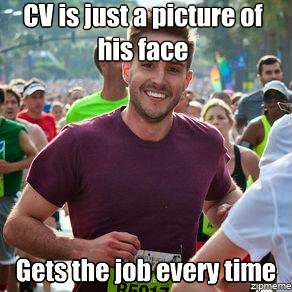
 Likewise, attractive people may be destined for happiness if we believe that good looks alone are enough to bring all good things in life.  Which brings us to this week's meme:


The premise is that, if you are as attractive as Ridiculously Photogenic Guy, your entire résumé (or curriculum vitae) can just be a head shot because you will get any job that you want based on your stunning good looks.  So does attractiveness trump skills for every job application?  The real life answer is a bit more complicated.

Jahwahar and Mattsson (2005) conducted two experiments to test this idea.  Of particular interest is Experiment Two because the participants were actual Human Resources professionals.  These HR workers (36 female and 25 male) were asked to evaluate four candidates for a job by looking at the candidates' test scores and head shots.  They were instructed to choose one person to give the job to, and to evaluate on a scale of 1-5 how likely they would be to give that type of job to each candidate.

They were not told that:

*the four candidates were always one attractive woman (Julie), one less attractive woman (Stacy), one attractive man (Paul), and one less attractive man (Richard).  The attractiveness level of each candidate's photo was verified in this and in previous studies. (But if you are named Stacy or Richard - don't worry!  The names were chosen to indicate the sex of the candidates.).

*the test scores from the candidates were invented to give the impression that there was no difference in skills or aptitudes that would make a candidate better or worse for the job.  The same scores were always used but, depending on the job in question, the supposed test was given a different name.  For example "Sales Potential Test" and "Social Work Aptitude Test" were used to label the same results for different jobs.

*the job that they needed to consider was either a male-dominated job, automobile sales supervisor; or a female-dominated job, school social worker.  The gendered domination was determined based on a report from the Bureau of Labor Statistics.  Each HR worker considered only one of these jobs for the four candidates.

*their level of Self-Monitoring was being assessed.  The HR workers completed a Self-Monitoring Scale (Snyder & Gangestad, 1986).  High Self-Monitors are very aware of and concerned about the impression that they give to others and of the impressions that others give off.  Low self-monitors are less aware of and less concerned about those impressions.

Their results suggest that Ridiculously Photogenic Guy may sometimes have a slight advantage - by being a guy or by being attractive - but not always.  It may depend on the type of job he applies for and the characteristics of the person who is evaluating him.

The HR workers in Jahwahar and Mattsson's Study 2 were influenced by the gendered nature of the job:  they were more likely to hire a man (65%) or highly endorse a man to become an automobile sales supervisor; they were also more likely to hire a woman (67%) or highly endorse a woman to become a school social worker.  This effect was further clarified by separating out the data based on the participants' levels of Self-Monitoring.  Low Self-Monitoring HR workers did not follow this gendered trend in hiring; but High-Self Monitoring participants were very likely to hire more men for the "male job" and more women for the "female job."


Attractiveness also seemed to give an advantage:  62% of all hires were the more attractive candidates, Julie and Paul.  And, when evaluated by High Self-Monitoring HR workers, attractive men and women received higher ratings for jobs that are dominated by the opposite sex.  For example, High Self-Monitoring HR workers rated Paul higher than the less attractive Richard for the school social worker job.  Low Self-Monitors did not show that same influence.

So Ridiculously Photogenic Guy may have an advantage by being attractive.  Moreover, a High Self-Monitor is more likely to hire him for a male dominated job (because he is a guy) and also more likely to evaluate him well for a female dominated job (because he is ridiculously photogenic).  But what about the rest of us who are applying for jobs?

These effects were not huge, but when there is only one position available and lots of qualified candidates it might be small differences like these that drive the final hiring decision.  Thus, Jahwahar and Mattsson have a somewhat creepy suggestion:

Given these results, what can applicants who are less attractive do to overcome selection bias against them? ...the bias against less attractive individuals may not be because of (lack of) attractiveness per se but may be because of the assumption that such individuals are less socially skilled than attractive individuals. If this is true, then less attractive applicants could moderate the impact of their appearance by demonstrating social skills and directing the interviewer’s attention to other strengths. Likewise, applicants whose sex is incongruent with the sex type of the job should provide as much individuating information as possible to minimize gender-stereotyped inferences of their attributes and trigger more controlled information processing (p. 572).

This seems disheartening - those of us who are not ridiculously photogenic should shoot for Miss or Mister Congeniality? (Really, I am a nice person - just LOOK at my social skills!)  Also, didn't their study just suggest that personal factors like attractiveness can sometimes trump skills?  Another issue is that there can be other variables, such as ethnicity, that were not considered by the present study - maybe the stereotype of your ethnicity trumps your attractiveness level or interacts with your sex - so why stress out over improving your attractiveness level when you cannot easily change your ethnicity or sex? And we can never control the characteristics of the person who interviews us.

In the end, the signs that I see around campus imploring our new graduates to iron their shirts and dress up for interviews probably have it right:  look your best and sell your strengths.  We cannot all be ridiculously photogenic, but all of us can get a job.  And when that job means that you get to make hiring decisions, monitor yourself so that stereotypes don't play a starring role in your decision making process.

Further Reading:

Listen to "The Ugly Duckling" or "Den Grimme Ælling" in its native language, Danish!

The Jahwahar and Mattsson (2005) article can be accessed in its published form through your local college library.

Take a Self-Monitoring assessment that was developed by Snyder in 1974.  Do you agree with the results?

Buzzfeed's take on the benefits of being attractive.  I'm not sure of the accuracy of their sources, but entertaining to watch.  How do you think most viewers feel about this video?

In case you need some inspiration - don't forget: You Are Beautiful.